
Name the change you suspect
When you ask Proofline to investigate in Slack or on a pull request, you can name the pull request or commit you suspect. The answer then says first what Proofline found about that change, and the change ranks above the other changes with the same timing. Naming a change orders the leads. It never makes that change the cause.
Write the change so Proofline reads it#
Proofline reads four spellings in your question, for example @prooflinedev investigate production: checkout returns 502 since northstar-demo/store-api#8:
- A pull request link, such as
https://github.com/northstar-demo/store-api/pull/8. owner/repo#N, such asnorthstar-demo/store-api#8.#N, such as#8, when the environment has only one repository.- A commit SHA of at least seven hexadecimal digits, such as
9f2c1e7.
A pull request counts only in a repository the environment links. Case does not matter in the owner and repository names. A reference to any other repository is passed over. Proofline reads up to five changes, in the order they appear. When you ask on a pull request, that pull request counts as the first, whatever the question says.
In Slack, Proofline also reads the reviews of the first three pull requests you name, even when they are older than the reviews it reads by default or never deployed. A reviewed pull request can then be a lead.
Read the answer#
Before the likely cause or the leads, the answer gives one line for each change you named, for up to three of them:
- The question names lead N: the change is lead N, and the line repeats the lead's timing, followed by when the records Proofline read show it merged and first deployed successfully to the environment. The lead keeps its own place in the list. A named change that is the likely cause is stated once, as the likely cause.
- Not among the changes Proofline read: no lead holds the change, and the line gives the window Proofline read.
- Matches several changes Proofline read; write more of its digits: the commit SHA you wrote begins more than one lead's SHA. Ask again with a longer SHA.
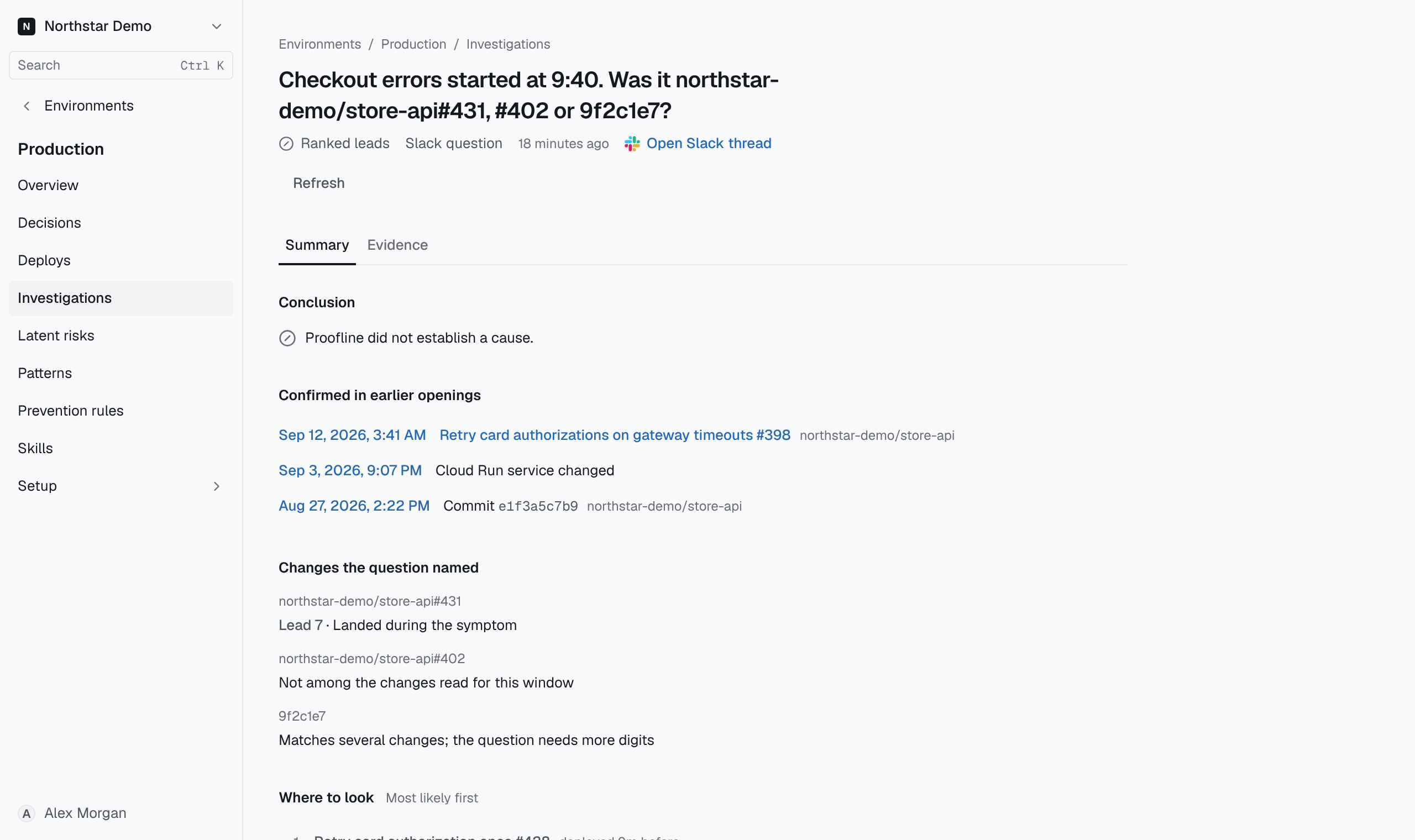
On the investigation page, Changes the question named lists each change as you wrote it. A change that is a lead links to it, such as Lead 7, with its timing. The others read Not among the changes read for this window or Matches several changes; the question needs more digits.
"Not among the changes read" means that, as far as Proofline's records show, the change did not merge, deploy or get reviewed in the window Proofline read. It does not mean the change never deployed, and it does not mean the change does not exist.